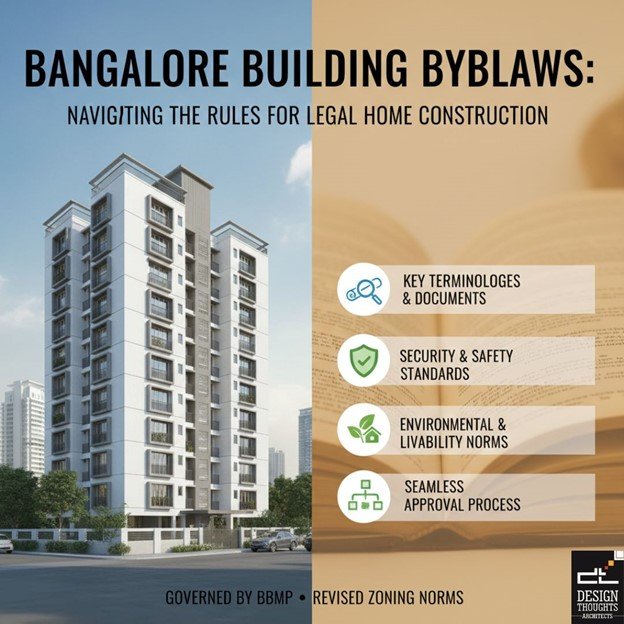
Understanding Bangalore building bylaws is critical if you are building a home, as these are the fundamental set of rules that regulate the construction industry. It ensures the security, safety, livability, accessibility, and environmental quality of your home, not just for today but for years to come. In Bengaluru, these rules are administered by the BBMP and are revised regularly in accordance with updated zoning norms issued by the government. Understanding the BBMP rules for house construction is vital to getting the approvals for your dream home without any hassle.
Throughout this blog, you will also be briefed on the required documents, the terminology often used in these rules & the construction field, and how to build your home legally and seamlessly. Before we jump into the blog, here is a quick checklist before finalizing your plan.
Checklist for homeowners
1. After buying your plot, get a site survey done.
2.Know about the specific setback for your plot.
3.Calculate the maximum built-up area based on which zone’s permissible FAR.
4.Think about the number of car parkings to fit in your plot.
5. Once your plan is designed by an architect, apply for sanction before construction starts.
Bangalore building bylaws and their governing bodies
What are the Bangalore building bylaws?
Every city has its own set of rules for new buildings, as these add to the urban fabric. With an increasing population, each household requires a connection to the basic amenities, light, and ventilation, fire safety, and emergency access too. A homeowner requires two important documents, for which it is mandatory to comply with the Bangalore building bylaws. These are building plan approval and occupancy certificates. Without these, your home, even after being built, will be considered illegal, and further restrictions on utilities or, in extreme cases, lead to demolition.
Key approvals: Building plan + OC
Here, let us understand the steps to get your plan approved one by one. Although it may seem like a lengthy process, it is typically handled by consultants when you hire the right team of architects, who do not overlook the mandatory Bangalore building bylaws.
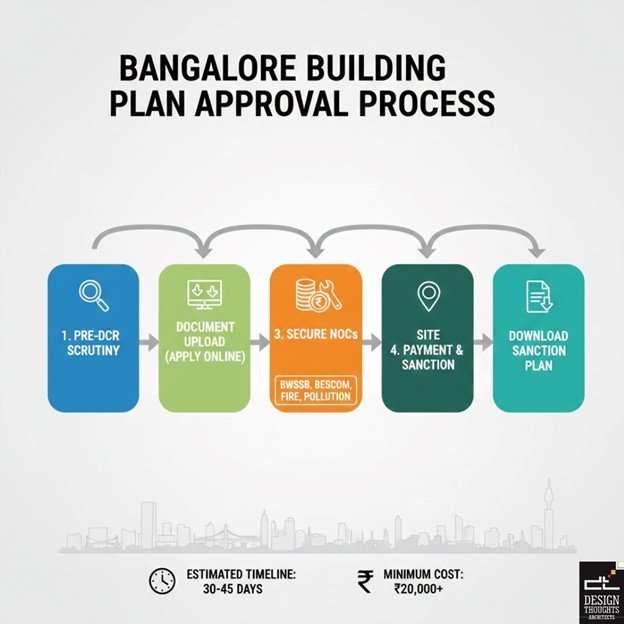
● Building Plan Approval – To obtain this approval, homeowners should hire an architect to draft the plan in accordance with BBMP (Bruhat Bengaluru Mahanagara Palike) rules and upload it to the BDA (Bangalore Development Authority) portal.
● The required documents include the khata certificate, sale deed, property tax receipts, NOCs from various departments such as BWSSB (Bangalore Water Supply and Sewerage Board), the fire department, and the pollution board, and architectural/structural drawings.
● The time required for this process may range from 30 to 45 days, and the cost starts at Rs. 20,000 or more, depending on the site area and built-up area.
● You can track the status of your plan as officials verify it, sometimes with a site visit. Once approved, a sanction plan PDF comes to you in a downloadable format.
An infographic for the building plan approval in Bangalore
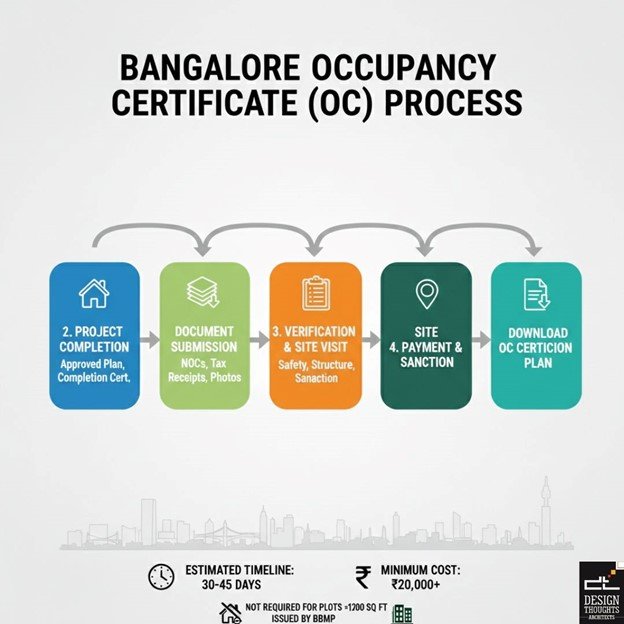
The next document required is the Occupancy Certificate (OC), which is issued once your project is complete. This is not required for plots below 1200 sq. ft.; however, it is an exception in certain areas where OC becomes mandatory. You can check this online on the BBMP website. In other cases, the following steps are required to obtain approval.
● The OC is mainly required for loan approvals and resale value, which are the primary reasons it is part of the BBMP rules for house construction.
● This certificate also confirms whether the plan meets the standards for structural, sanitation, fire safety, and other environmental concerns.
● This can also be done online if the following documents are ready: an approved building plan, a completion certificate, a structural stability certificate, NOCs from the pollution board, fire safety approval, property tax receipts, and completed photos of the project.
An infographic for obtaining OC in the post-construction
Who governs them?
The height of the building and the setback or space around it are usually specified by the BBMP rules for house construction. The general thumb rule is that wider roads facilitate better circulation and emergency access, and hence permit taller building heights and wider space from the boundary to the building. Another aspect that varies with road width is the FAR, or Floor Area Ratio.
Let us break down these terms one by one to understand better.
Key rules: Setbacks, FAR, parking, height
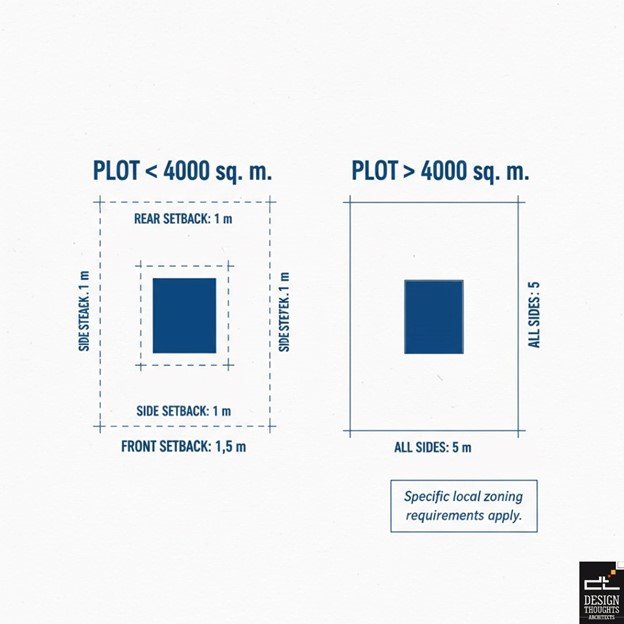
Setback is the minimum distance from the boundary of your home to the actual building property. This helps with light and ventilation in the home, allows access for services, and provides privacy from the neighbourhood buildings. Thenew setback rules of 2025 define the following.
Here are the latest setback rules followed in Bangalore:
For plots less than 4000 sq.m,
● Front setback: Minimum 1.5 m
● Side setbacks: Minimum 1 m (each)
● Rear setback: Minimum 1 m
For plots exceeding 4,000 sq. m., the setback on all sides is 5 m. However, this change is in specific local zoning requirements.
Setback regulations for residential projects in Bangalore
Parking requirements
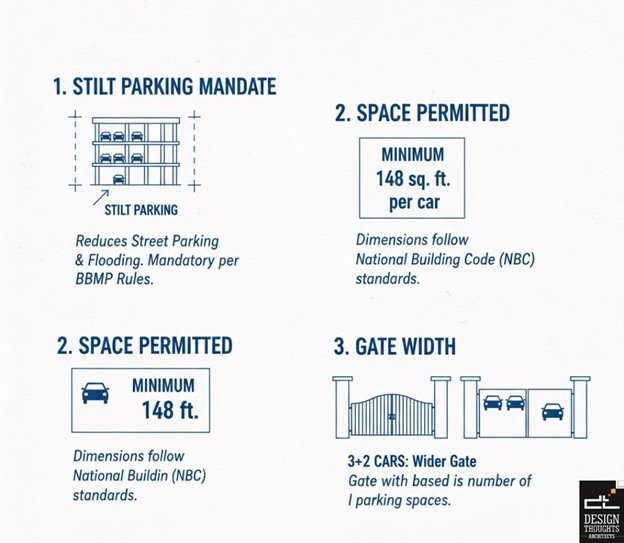
Parking requirements are a part of the Bangalore building bylaws, mainly to reduce street parking. They have also introduced stilt parking and made it mandatory under the BBMP rules for house construction, as it also reduces flooding in homes. The number of parking spaces depends on the number of families residing in the home. However, the parking dimensions should comply with the National Building Code standards.
For example, for one car parking space, the dedicated space should be a minimum of 148 sq. ft. Also, the gate width should be determined by the number of parking spaces in the home.
Setback regulations for residential projects in Bangalore.
FAR (Floor Area Ratio)
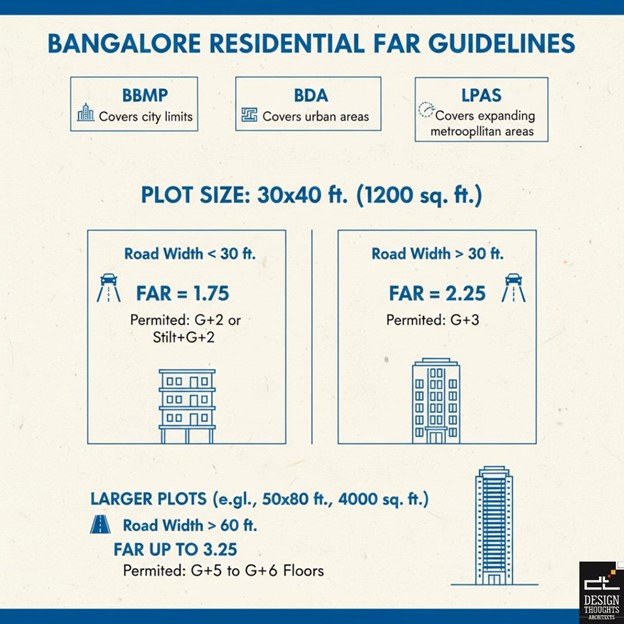
Depending upon the urban density, FAR is defined as a regulatory metric which also changes based on the plot size, whether it is residential or commercial, road width, and also the jurisdiction in that particular area, which can be BBMP, BDA, or LPA (Local Planning Authority). To give a clearer understanding, BBMP covers city limits, BDA covers the urban areas, while the LPAs cover the expanding metropolitan areas.
FAR is the fraction of the total built-up area of the plot. Once you find the FAR for your plot, we can determine the maximum built-up area allowed on your plot. Here is a snippet of the guidelines in Bangalore.
For a 30×40 ft plot:
● If the road width is less than 30 ft., then the FAR is 1.75, allowing G+2 or Stilt+G+2.
● If the road width is more than 30 ft., then the FAR is 2.25, allowing G+3.
For larger plots, like 50×80 ft, 4000 sq. ft., the FAR can go up to 3.25 on roads that are greater than 60 ft, enabling G+5 to G+6 floors.
FAR in Bangalore and its governing bodies
Height restrictions & safety concerns
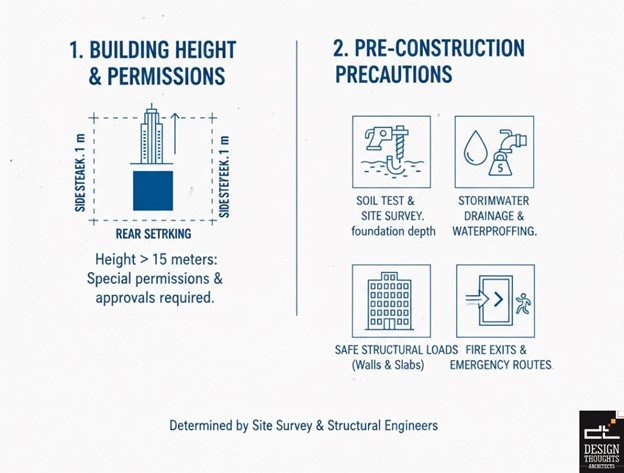
By this time, we know that the building’s height depends on FAR; however, for buildings exceeding 15 meters in height, special permissions and approvals are required.
These are the Bangalore building bylaws; in addition, we follow basic precautions before starting construction, including soil tests and site surveys to determine how deep the foundations can go. For taller buildings, the foundations may be deeper than required, and in such cases, a soil test is mandatory.
Other precautionary measures that you may require include stormwater drainage and waterproofing, safe structural loads for walls and slabs, and fire exits and emergency escape routes. These are usually determined with a site survey and by structural engineers.
Height and other precautions before construction
Common violations and penalties
A deviation or mistake in these is not to be overlooked; however, if you are not able to avoid any minor deviation, you can pay penalties for such cases. Let us also discuss the areas where your sanction plan should be mistake-free to gain approvals without any hassle.
● Ignoring setback requirements
● Parking spaces that are not compliant with the bylaws
● Calculating FAR incorrectly
● Building taller homes without proper road width compliance
● Not including stilt floor parking
In such cases, with rules getting stricter year by year and an increased population, a question might arise in homeowners’ minds: how to build a home without compromising user requirements while abiding by the Bangalore building bylaws. Let us decode the answer for this, too.
How do architects help you comply?
Meeting requirements within the legal setbacks
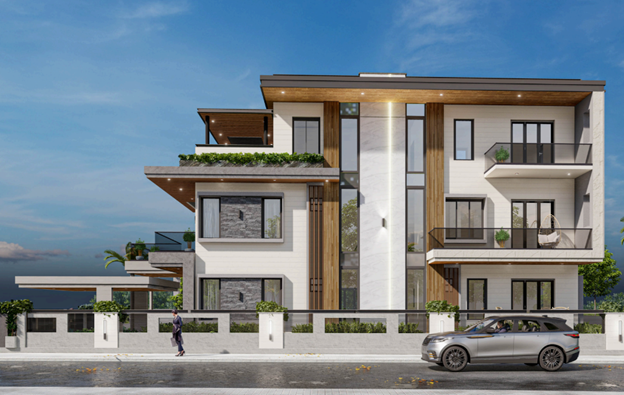
As a homeowner, you would’ve thought about the requirements for your dream home for a long time. And when you finally face the reality of stringent setbacks, parking, and height restrictions under Bangalore’s building bylaws, it may be a shocker for you. However, we architects can help you with efficient planning that nullifies this question.
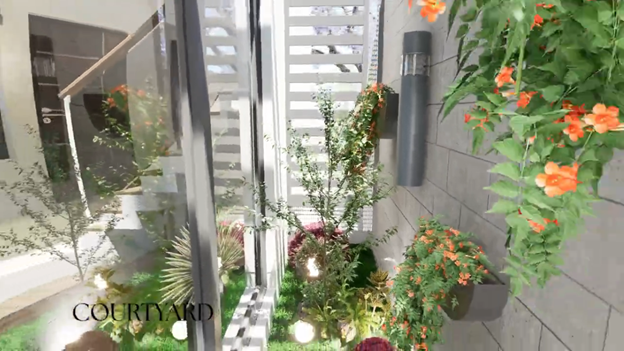
Landscape in the setback extension
For instance, here the setback becomes an extension of the courtyard. Once you slide open the doors, the exterior blends with the interior spaces, using the setback as an asset for the home. You can also use the setback as a kitchen garden, utility, balcony, or deck extension.
Achieving parking within the home premises
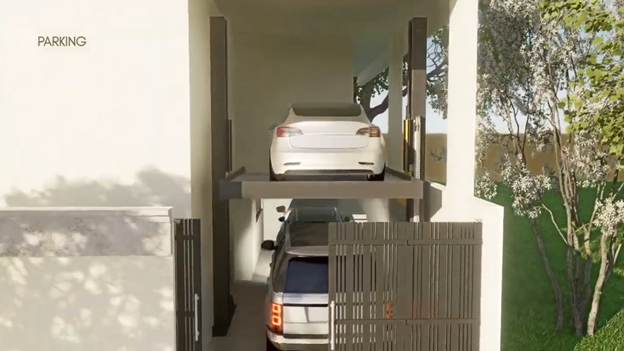
Sometimes, parking requirements may apply to more than two cars on a 30’ x 40’ plot. In such cases, we can install a mechanized parking space or introduce a cantilevered floor on the inside that serves as a shed for car parking within the home, avoiding street parking.
Stacked parking in one of our projects
These are just a few of the many design planning strategies that architects and designers consider to meet all requirements without compromising the Bangalore building bylaws.
Concluding
As a homeowner, you may think of these Bangalore building bylaws as bureaucratic hassles, but they are framed to ensure absolute safety, quality, and environmental concerns. It also creates harmony among the neighbours and, in a broader perspective, sustains urban density in overpopulated cities. In this article, we have covered topics such as road width, access norms, FAR, setbacks, open space rules, and more.
We are also giving you a set of frequently asked questions for further clarification.
Frequently Asked Questions:
Khata is a legal document that records property tax details; hence, it serves as proof of the property’s legal existence.
● A-khata is issued when the property has all the approvals and no penalties or legal issues.
●A B-khata is issued when the property does not meet the Bangalore building bylaws and is deemed to be unauthorized construction.
Absolutely. A well-planned design can meet your functional and aesthetic needs without violating bylaws. Architects achieve this through:
● Efficient space planning
● Vertical zoning (G+1 / G+2 planning)
- Smart use of setbacks for light and ventilation
Good design works within regulations, not around them.
Building beyond the minimum setback is considered a violation. Even small deviations can:
● Delay or block your Occupancy Certificate.
● Cause issues during property resale or bank loans.
● Attract fines or demolition notices.
In most cases, it’s safer and smarter to redesign the layout than to risk legal trouble later.
BBMP building bylaws ensure that your home is safe, legally approved, and comfortable to live in. They regulate setbacks, height, parking, and structural safety. Following these rules is essential for obtaining building plan approval, an Occupancy Certificate (OC), bank loans, and resale clearance. Deviations can lead to penalties or legal notices.
The width of the road in front of your property directly impacts:
● The maximum building height
● The Floor Area Ratio (FAR)
● The number of floors allowed.
Narrow roads restrict vertical growth, while wider roads allow more built-up area. This is why accurate road width verification is crucial before finalizing your design.
Following these laws ensures a smooth construction of your home in Bangalore, as it makes it easier to obtain all approvals online.
Plot coverage refers to the area on the ground floor or otherwise, the footprint of the building on the ground. This does not include other areas, such as the total built-up area.
The responsibility of implementing these laws and verifying that each home that is registered in accordance with the laws is taken care of by the Urban Development Department.
Following these laws means you avoid all penalties in the approval process and ensure legal ownership of your dream home.
For sloped-roof houses, the height is measured from where the wall meets the roof, not from the roof’s tip. For flat-roofed homes, it is measured from the ground level to the roof level as a straight line.
LOOKING FOR THE BEST RESIDENTIAL ARCHITECTS IN BANGALORE?
Choose Design Thoughts Architects, the top residential architects in Bangalore, leading choice for premium home design.