Learn the complete home construction step by step process in Bangalore, from land verification and BBMP approvals to construction stages, costs, and handover – a step-by-step guide for homeowners.
To start
Building a home in cities like Bangalore is an exciting process for first-time builders, investors, and home builders. However, it involves a number of technical stages, layered approvals, and proper chronological planning. We shall discuss the home construction step by step process to understand how these work in Bangalore.
Let us go through this from when you buy your land till the project is handed over to you. This detailed blog will become a checklist that you can follow in the process.
Land and its related documents
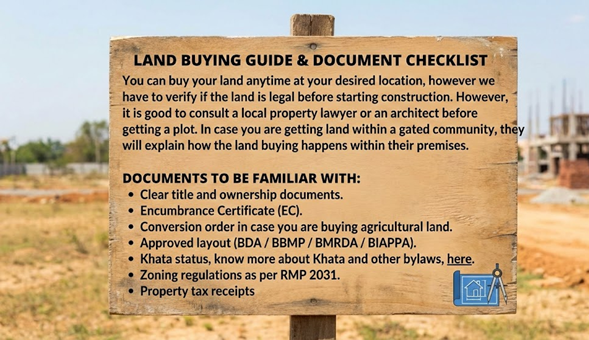
You can buy your land anytime at your desired location. We have to verify if the land is legal before starting construction. However, it is good to consult a local property lawyer or an architect before getting a plot. In case you are getting land within a gated community, they will explain how the land buying happens within their premises.
Here is a list of documents that you should be familiar with while buying land.
- 1. Clear title and ownership documents.
- 2. Encumbrance Certificate (EC).
- 3. Conversion order in case you are buying agricultural land.
- 4. Approved layout (BDA / BBMP / BMRDA / BIAPPA).
- 5. Khata status: learn more about Khata and other bylaws.
- 6. Zoning regulations as per RMP 2031.
- 7. Property tax receipts
Quick checklist for land-related documents
Soil test and site survey
These are tests that need to be performed mandatorily before initiating the construction. Architects recommend proceeding with construction only after these tests are complete.
What is a soil test?
A soil test determines soil bearing capacity and helps in determining the safe foundation type, which includes isolated footing, raft, pile, etc. This helps in preventing future settlement or cracks.
What is a site survey?
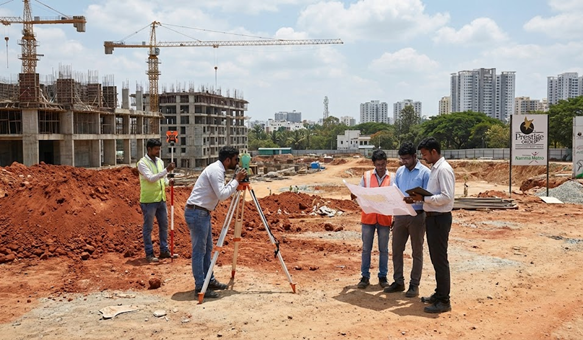
This determines the exact plot dimensions, levels, boundaries, and orientation. This data is critical for structural safety and approval drawings. Also, these help the architects to properly plan your house with standard setbacks and in proper orientation.
Skipping these steps can become a problem in the approval stages. This is an important part of the home construction step by step process.
Engineers conducting site survey and soil tests
Architectural and structural drawings
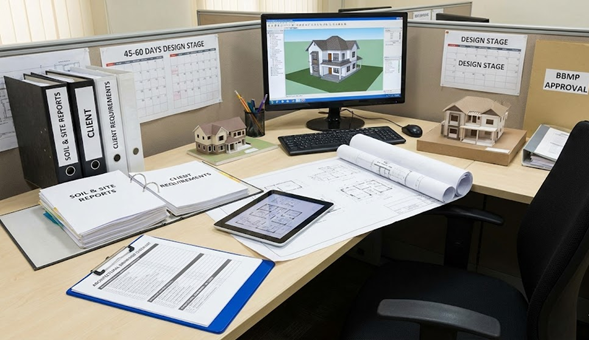
Architects collect the soil reports and site survey reports to begin with accurate planning. This happens after they collect the accurate requirements for the spaces the clients want exactly. You can make a list of rooms for the family members with regard to room sizes, parking, and Bangalore bylaws.
Here is a list of drawings that you can ask your architects in the home construction step by step process.
1. Floor plans as per elevation
2. Elevation & 3D views
3. Sections & Elevation drawings
4. Door and window details
5. Lintel drawings
6. Area statements
7. Electrical drawings
8. Plumbing drawings
9. Wall sections
Along with this, you can also ask for structural drawings that will be done either by the in-house structural engineer or a consultant that the architect will recommend to you. This entire set of drawings, along with the technical drawings that are cross-verified with one another, is critical for construction.
This design stage is the most important of the entire home construction step by step process. It takes about 45 – 60 days to conclude this stage, depending on the number of revisions from the client.
Here is a checklist for the list of structural drawings:
1. Foundation drawings
2. Column, beam, slab details
3. Staircase structure
Just like the bylaws, these structural drawings follow IS codes that make sure that the structure is durable and earthquake-resistant. While these stages take place, you can send the final sets of plans for approval from BBMP in the meantime.
Drawings, models, and documents that make your home
Appointing a contractor
Some homeowners start their home construction step by step process by appointing a contractor, which will create several inconsistencies in taking approvals. Bringing in an architect before a contractor cuts down any legal challenges for your home construction. After the plans, elevations, and technical drawings are prepared, the architects give you a comparative statement for the contractors available to them.
There are two types of contractors homeowners can choose from: labour-only contracts, which provide materials but do not take responsibility for the entire construction, and turnkey contractors, who provide end-to-end support.
Another critical stage that is dealt with here is the BOQ. Check this detailed blog on Bill Of Quantities and its importance for the home construction step by step process.
Get set for construction.
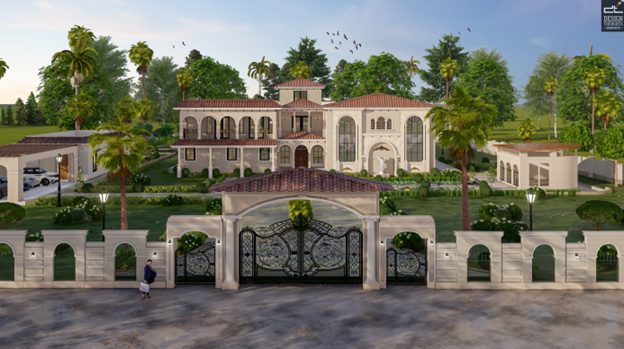
The above steps are sufficient to start the construction of your dream home. Let us understand the practicality of construction and how it becomes a reality from paper. We can understand this better with a project and its construction process, like a story. Here, we will use a Mediterranean-style home to explain the construction process.
The clients are from Dubai and wanted a retreat in Bangalore. The design phase ended in the last quarter, and the project is getting built in full-fledged mode.
Stages of construction
Before we jump into the project, it is crucial for the clients to understand that the contractors hired by them should thoroughly read and understand the entire set of drawings. The process then follows:
1. Site marking as per the sanctioned plan
The boundary of the site should be marked clearly and followed by footing marking. Having an engineer on site before doing this can be beneficial; if not, the contractor will supervise the process.
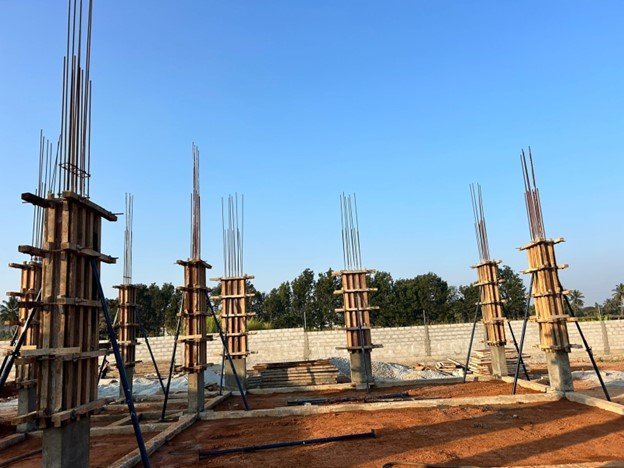
Site marking process and compound wall in the site near the Nandi Hills for the farmhouse
2. Excavation
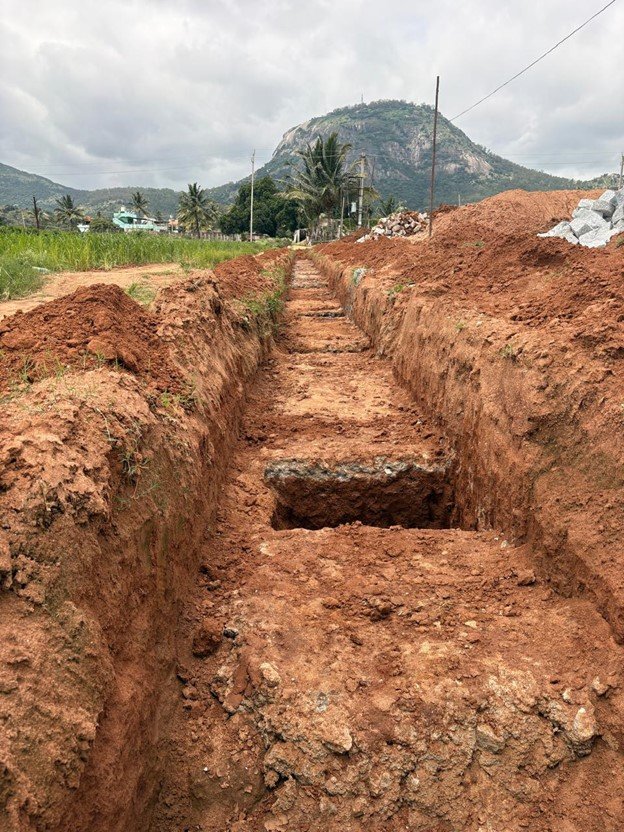
The next procedure is excavating for the foundation, and this is up to the depth specified by the engineer based on the soil test reports.
The excavation process was done according to the soil reports and drawings
3. Foundation work
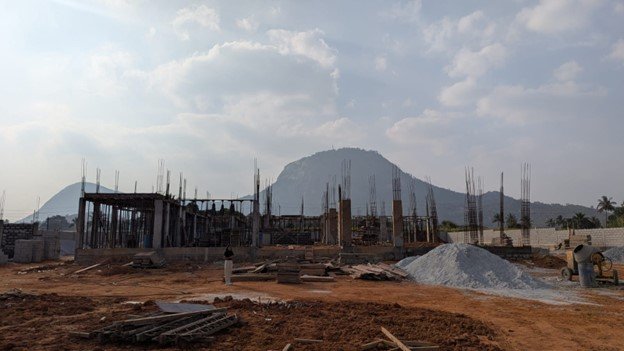
The excavated earth is removed from the site, and a layer of stones is laid for strength to add strength to the foundation. This is called soiling, and a layer of PCC completes the foundation work.
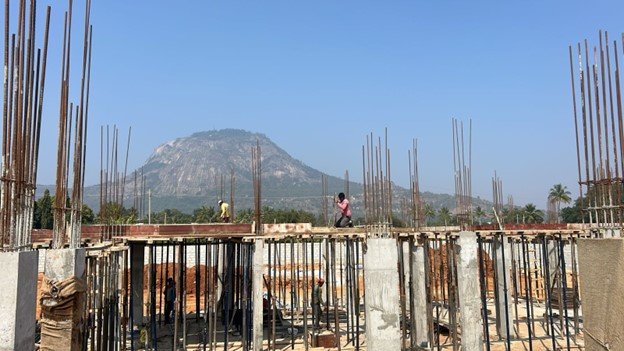
A view of the site, along with the scenic hills behind
4. Footings and plinth beam
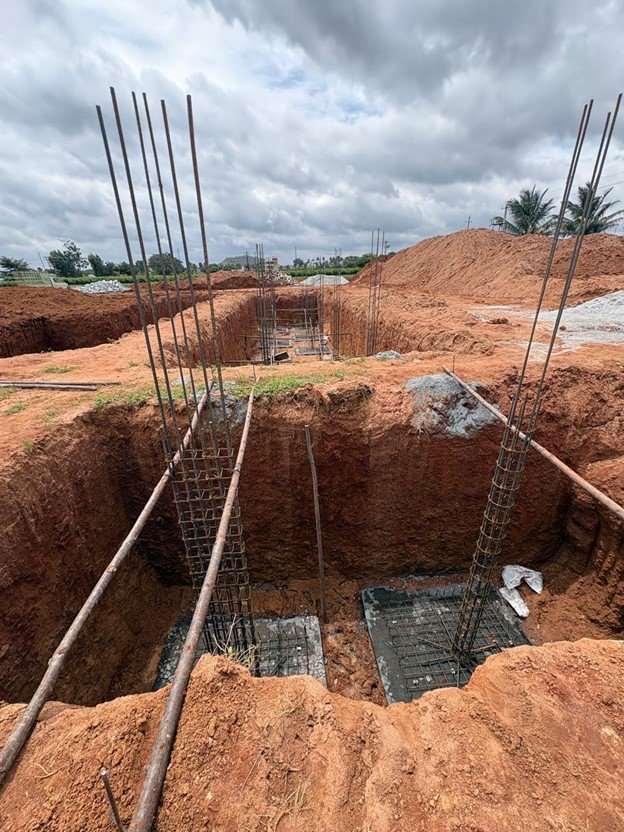
A minimum period of curing is required for the PCC, after which footings and columns are extended from the base. The beams connecting each column extension from this make the plinth or the ground floor profile of the house.
Plinth beam process on the site
5. Anti-termite treatment
Termites are no longer part of the home in modern construction, as this process is mandatory after the plinth stage. This also requires a few days of curing before the next step.
- 6. Backfilling
The excavated earth from the excavation stage is backfilled into the foundation to complete what is called the sub-structure of the house.
Here is a quick checklist for you to track the home construction step by step process during the sub-structure level.
1. Site Preparation & Excavation
● Site cleaning
● Temporary fencing
● Setting out as per the drawing
● Excavation for the foundation
Excavation depth depends on soil and structural design.
2. Foundation Work
● PCC (Plain Cement Concrete)
● Footing reinforcement
● Footing concreting
● Column starter casting
This is one of the most critical stages of construction.
3. Plinth Work
● Plinth beam casting
● Backfilling with proper compaction
● Anti-termite treatment
● Plinth level marking
After this stage, the building outline becomes visible.
Super-structure construction
The super-structure is the preparation of everything that comes above ground. Let us understand this process in the form of a checklist, too.
Casting
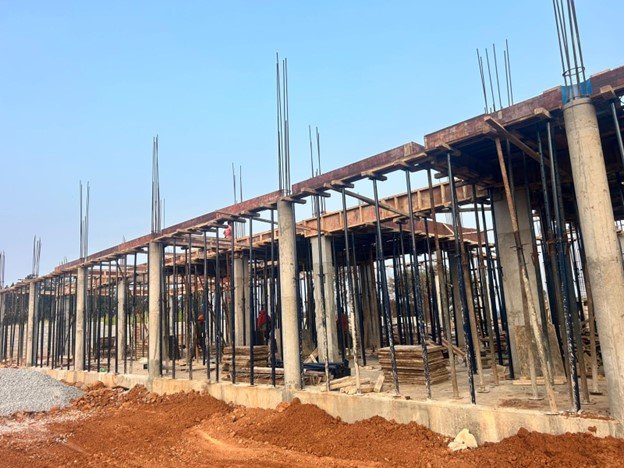
After the plinth is done, the columns and slabs are cast. Casting is the process of creating a shutter accurately and pouring RCC into it. This requires a minimum curing time of up to 21 days, after which the slab or column is ready. After this staircase construction is done, the slab or column is ready.
Slab shuttering done for the Mediterranean home, notice the round
Masonry work
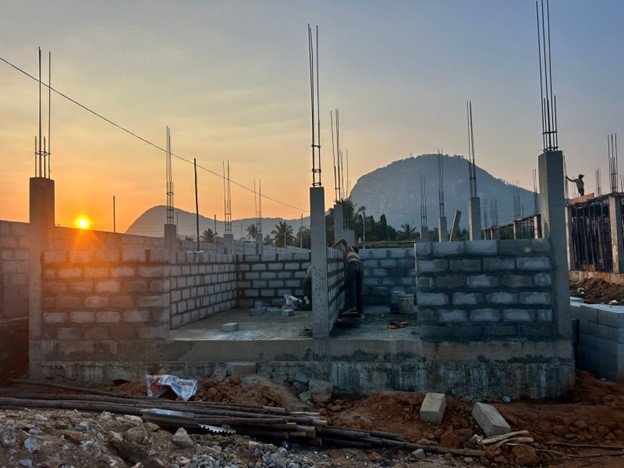
Casting is like the skeleton of the building, while masonry is the arrangement of bricks or ACC blocks into walls. These are not structural members but make up the boundary of the home through walls and partitions.
Beginning of concrete block masonry on the site
Electrical and plumbing works
The next step is locating the DB box, conduits, and switch boxes according to the electrical drawings. Once this is done, the plumbing lines, drainage, soil pipes, and bathroom fitting layouts are complete according to the plumbing drawings.
Plastering
Until this stage, the major construction work is complete, and the next steps are finishing the building. The conduits and plumbing points are covered in plastering, and the walls are smoothed. All internal and external walls are plastered, and waterproofing for toilets and terraces is done. This is also an important part of the home construction step by step process, as proper curing in this stage is needed to avoid cracks.
Flooring
The clients choose the type of flooring and tiles for the house during the BOQ stage. This varies from Italian marble, vitrified tiles, granite, wood, and much more.
Flooring as seen in the renders for the Mediterranean home
Doors & windows
Doors and windows are either customised on site or factory bought according to the client, which is done with the materials that the client selects. The materials include teak or honne wood for doors, UPVC, aluminium, or wood for windows.
Doors and windows in the farmhouse
Paints and colours
From this point, the involvement of the client allows you to choose paint colours, interior finishes, false ceiling, and all other finishes for the home according to the budget.
False ceiling for the home
External designs
The final stage is completing the gate design, compound walls, railing, sump tank, landscaping, and the driveway for the house, bringing the home construction step by step process to a close.
Compound wall and grill gate as proposed for the house
Final procedures
Make sure to get a complete final check done with respect to plumbing, electrical, workmanship, and fixing defects, if any. Before moving in, get your “Occupancy Certificate” done along with proper electricity and water connections for your home. Also, obtain the final cleaning and warranty documents for appliances, hardware, and automation technologies, if any.
Wrapping up
As we come to the end of the home construction step by step process, we get to know that the construction process is a coordination with homeowners, architects, and contractors; however, we see that several other people, like vendors, electricians, plumbers, are also involved.
A peaceful home for the future means proper planning that clears out all the legal documents. And for that, choosing the right team of architects is necessary. If you are looking for a dedicated team for your project with trustworthy contractors, project managers, and service teams, we are here to make your dream project a reality.
Frequently Asked Questions:
The house construction process in Bangalore includes land verification, architectural planning, BBMP or local authority approval, foundation work, superstructure construction, finishing works, and obtaining completion certificates before handover.
On average, constructing an independent house in Bangalore takes 10 to 14 months, including planning, approvals, and construction for a G+1 residential building. Timelines may vary based on design complexity and approvals.
You need plan approval from BBMP, BDA, BMRDA, or BIAPPA, depending on plot location, along with Khata documents, sanctioned drawings, and later a Completion Certificate (CC) and Occupancy Certificate (OC).
House construction cost in Bangalore typically ranges from ₹1,800 to ₹3,500 per sq. ft, depending on material quality, design, number of floors, and contractor type.
Yes, a soil test is highly recommended and often mandatory for structural design. It helps determine the correct foundation type and ensures the long-term safety of the building.
Within city limits, BBMP approves residential plans. Outside BBMP limits, approvals are handled by BDA, BMRDA, or BIAPPA, based on the jurisdiction.
Turnkey contracts are preferred for hassle-free construction, while labour-only or material-and-labour contracts offer more control over costs. The best option depends on budget and involvement level.
Yes, rainwater harvesting is mandatory for residential buildings in Bangalore as per BBMP and BWSSB regulations and is required to obtain plan approval and water connection.
LOOKING FOR THE BEST RESIDENTIAL ARCHITECTS IN BANGALORE?
Choose Design Thoughts Architects, the top residential architects in Bangalore, leading choice for premium home design.